


Every strategy and guide published by North Shore is backed by the board-certified expertise of our Co-Founders. With decades of combined experience in holistic admissions, Amy and Debbie ensure our guidance is objective, unbiased, and focused exclusively on your student's best fit.
The transcript is the first thing an admissions officer reads when they open a file, and most families do not realize it is also the document being read most carefully. The essay gets the attention, the activity list gets the conversation, and the test score gets the parent's anxiety. The transcript gets the read that shapes everything else. By the time an admissions officer reaches the personal statement, the transcript has already decided what kind of story the essay needs to tell.
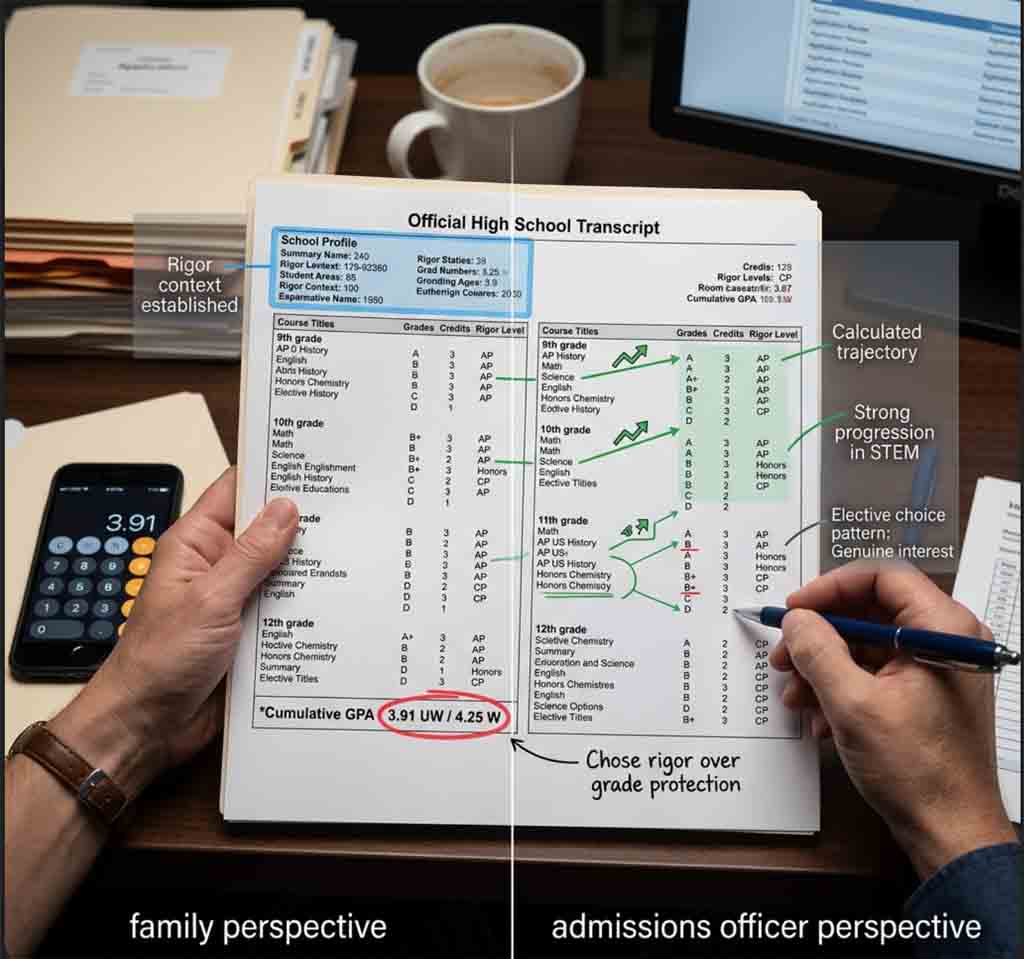
Admissions officers read a transcript in three layered passes: the high school's profile first, then the course choices made inside it, then the grades against those choices. They are not reading the GPA as a number. They are reading the transcript as a record of decisions — what the student took, when they took it, how they did, and what those choices say about how this student approaches their own education. Families consistently read the GPA. Admissions reads the pattern.
What Inside the Admissions Office™ refers to, in the transcript context, is the read most families never see — the read that happens before the GPA enters the picture.
The first thing admissions officers look at on a transcript is the high school profile — not the GPA, not the grades, not the course list. Every high school sends one: a one- or two-page document describing the school's curriculum, the courses offered, the grading scale, the percentage of students taking advanced courses, and the typical college destinations. The profile is the reference frame for everything that follows. A B+ from a school where ninety percent of students take AP courses reads differently than a B+ from a school where ten percent do, and the reader knows that before they see a single grade.
After the profile, the reader scans the course list — not the grades — first. They are reading for choice. What did this student elect to take in each year, in each subject, when they had options? Did they continue with the language through level five, or stop at level three? Did they take the harder math track or stay one level down? Did they elect a fourth year of science, or fill the slot with something else? The pattern of choices is the first signal of how this student thinks about their own academic development. The reader is building a picture before any grade enters the read.
Only then do the grades come in, and they are read against the course choices, not against each other. A B in BC Calculus reads differently than a B in pre-calculus, and the reader is doing that comparison automatically. The student who took the harder course and got the B is often read more strongly than the student who took the easier course and got the A — because the harder course signals a particular kind of decision-making the admissions office values.
The reader is not reading for GPA optimization. They are reading for academic ambition calibrated to capacity.
After 18 years inside this process, the most consistent gap between what parents track and what admissions reads sits in one place: the GPA conversation versus the read of the transcript as a record of decisions made under uncertainty. Parents follow the GPA. Admissions reads the pattern.
The reframe that matters most for families inside the transcript is the trade-off most never see. A higher GPA from easier courses can actively weaken an application, because it tells the admissions reader the student or the family was optimizing for the number rather than for the development.
Three students. Three transcripts. Three different reads.
The student who took five APs as a junior, got three B's and two A's — reads as overextended. The schedule signals someone optimizing for a number on the application rather than for genuine learning.
The student who took three carefully chosen advanced courses and earned A's in two, with a B in the hardest — reads strongly. The schedule signals someone choosing real challenge with honest results.
The student who took the easier track across the board and earned all A's — reads as someone whose GPA is high because the choices were calibrated to keep it high.
The first and third look similar in the family's GPA conversation. They read very differently in the admissions office.
This is what Inside the Admissions Office™ means in practice. The transcript is not a number. It is a decision history, and the reader is reading it as one.
The harder reading is that this calibration is not something a family can correct retroactively in senior year. The record is built across four years, and the decisions made in ninth and tenth grade — when the family was not yet thinking about admissions — often shape what's possible by senior year more than any single decision after. The window to make these choices well is wider than families realize when they start paying attention in junior year, and narrower than they realize when the senior schedule is being planned.
None of this is fixable retroactively. This is the kind of reading that informs essay strategy, school list calibration, and how the application gets positioned — not the senior schedule, which for most students is already set by this point in the year. The students whose families look at the transcript this way arrive at application season with a meaningfully different sense of what their file is doing.
Q: Does the unweighted or weighted GPA matter more to admissions?
Answer: Neither, in the way most families ask the question. Admissions readers recalculate GPAs themselves using their own methodology, and most ignore the school's weighted GPA entirely. They build their own read from the course list and the grades. The number on the transcript is a starting point, not the answer.
Q: My student's transcript already has weaknesses we can't change. How much does this hurt the application? A: Most transcript weaknesses are recoverable in interpretation — the question is whether the rest of the file resolves them or amplifies them. A B in honors physics that pairs with strong work in the student's intended major reads differently than the same B in a student applying as a physics major. The transcript's weak spots are read in context. The work in front of the family is making sure the rest of the file makes the right context visible — through the essay, the activity list, and the school list — rather than leaving the reader to fill in the gap unfavorably.
Q: How important is the senior year schedule if applications are due in November or January? A: Highly important. The senior schedule is on the transcript when the application is read. Admissions readers explicitly look at it as a signal of how the student is choosing to spend their final year of high school, knowing applications are in. A senior schedule that signals coasting is one of the most consistently damaging patterns we see, and it is fully visible to admissions even before final grades arrive.
Q: What happens if there's a grade drop in junior year? A: It depends entirely on the context. A drop in one course is often read as honest difficulty in a real challenge — frequently neutral or even positive if the course was a genuine stretch. A drop across multiple courses signals a different question. The reader is looking for the explanation in the rest of the file, and what they find there shapes how the drop is interpreted.
Q: Should the student take pass/fail electives to protect the GPA? A: Almost never. Pass/fail electives in selective admissions almost always signal GPA optimization to the reader, particularly when they appear in core academic subjects. The exception is the genuine elective the student is taking for exploration outside the academic core. The pattern itself, repeated across the transcript, weakens the file more than the grade ever would have.
Q: When should families start thinking about transcript strategy? A: Ninth grade, in a loose sense — but most families don't have the framing to do this productively until later. The realistic answer is: by the end of sophomore year, the transcript-as-decision-history pattern is beginning to set, and adjustments made in junior and senior year have to work within the shape that's already there. This is the conversation we have most often in early intake sessions.
What requires more than a blog post: The specific read of this student's transcript through Inside the Admissions Office™ — the diagnostic work that turns the record into a strategic picture, not just a document — which is what NSCC's Application Blueprint™ Diagnose phase produces.
You don't have to navigate the complexities of college admissions alone. Whether you are aiming for the Ivy League, a top-tier public university, or a highly selective major, our expert counselors are here to help you craft a personal brand that stands out.