


Every strategy and guide published by North Shore is backed by the board-certified expertise of our Co-Founders. With decades of combined experience in holistic admissions, Amy and Debbie ensure our guidance is objective, unbiased, and focused exclusively on your student's best fit.
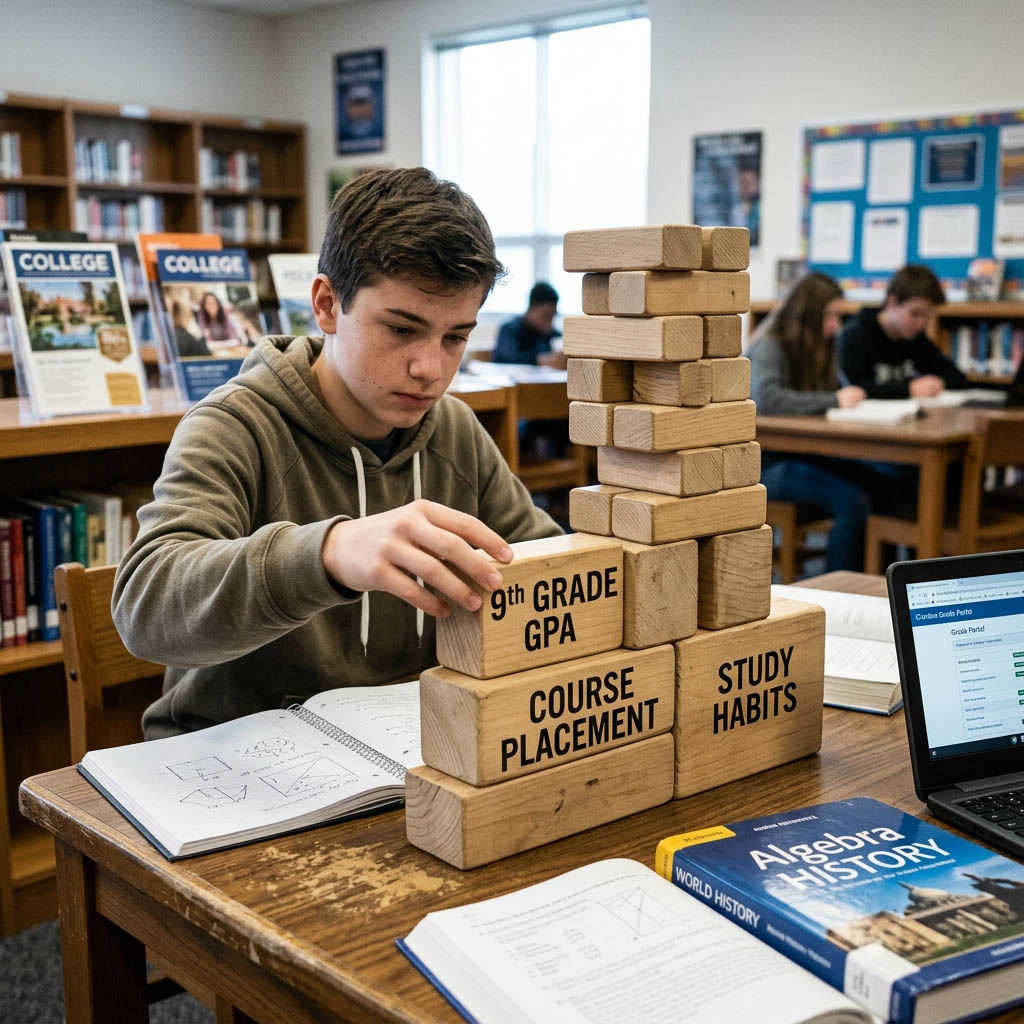
Most parents of rising 9th graders are thinking about the wrong things right now — which classes to sign up for, which sports to continue, and whether to redecorate the bedroom. The conversation that rarely happens before August is the one that matters most: your child’s freshman year will constitute approximately one-third of the academic record colleges evaluate when they apply. Not because of some obscure admissions quirk — but because of simple math.
When a student applies to college in the fall of their senior year, admissions offices evaluate three completed years of high school — freshman, sophomore, and junior. Senior year first-semester grades may arrive later, but the transcript that defines how a student is initially read is built entirely from 9th through 11th grade. That makes freshman year exactly one-third of the academic picture. The grades your child earns this coming September through June are not a trial run. They are a permanent, weighted component of how selective colleges will evaluate them.
Families often operate under the assumption that freshman year is a warm-up — a period of adjustment where grades can be low, effort can be inconsistent, and habits can be informal because “there’s still time.” Admissions officers interpret it very differently.
Selective institutions read freshman year in two specific ways:
This means the starting point is not neutral. It defines the story arc of the entire application.
There is a specific gap in parent preparation that appears repeatedly in competitive admissions: families invest heavily in middle school academics and extracurriculars, then treat the summer before 9th grade as a pause. It is not a pause. It is the single most consequential transition in the K–12 arc for college outcomes.
What changes structurally in 9th grade that families underestimate:
Parents often spend the summer before 9th grade focused on social readiness — whether their child will make friends, find their people, feel comfortable. These concerns are not only valid, they matter. Students who find their place socially are generally happier, and students who are happier are more successful across everything they do in high school. Social belonging and academic performance are not competing priorities. But neither is social readiness something that can be engineered in advance or checked off a list. What parents can do is create conditions for it to happen naturally — and one of the most effective paths to finding like-minded peers is through the activities, clubs, sports, and programs a student chooses to explore.
What carries real admissions weight from freshman year:
One of the most valuable things a rising freshman can do before school starts is research what their high school actually offers. Most students arrive in September without a clear picture of the full range of clubs, sports, fine arts programs, community service organizations, academic teams, and independent activities available to them. They end up defaulting to what they already know or what their friends are doing, rather than making informed choices. That default often determines four years of extracurricular involvement.
The summer is the right time to look at the school’s course catalog, athletic offerings, club list, and arts programs with fresh eyes — and to have a real conversation with your student about what genuinely interests them. Not what looks impressive. Not what they think colleges want to see. What they are actually drawn to. A student who is authentically interested in debate, robotics, theater, cross country, a cultural affinity group, the school paper, or student government will invest differently in that activity than a student who joins it because a parent or counselor suggested it would “look good.” Admissions readers are experienced at distinguishing between the two. Engagement that is real produces essays, recommendations, and depth of involvement that cannot be manufactured.
There is no category of activity that is inherently better than another for college admissions purposes. A student who spends four years in the school orchestra carries the same potential admissions weight as one who spent four years on the soccer field or leading a community service initiative — provided the involvement is sustained, meaningful, and genuine. What matters more than it seems is whether the student could speak compellingly about why they were there. What matters less than most families assume is whether the activity sounds prestigious on a list.
This is also where the social dimension of high school and the extracurricular dimension converge. Students who try out activities they are genuinely curious about tend to find others who are curious about the same things. That is where real friendships form and where students begin to feel like they belong somewhere at school. The student who joins the robotics team because they actually like building things is more likely to find their people than the one who joins because it seemed strategically advisable. Passion is a better navigator than strategy when it comes to both activities and friendships.
Here is where outcomes diverge in ways that are genuinely difficult to reverse:
A student who treats freshman year casually — earning B’s and C’s while adjusting to the social environment — and then dramatically improves in 10th and 11th grade faces a structural math problem. If they earn a 2.8 GPA freshman year, they would need to sustain approximately a 3.9 or above through sophomore and junior year just to arrive at a cumulative 3.5. That is not impossible. But it requires sustained excellence at an increasingly demanding level of coursework. It leaves no room for a difficult semester. And it means the transcript still shows that freshman foundation.
Contrast that with a student who exits freshman year with a 3.8 or above. They have built-in a margin. A harder sophomore year, one challenging course that produces a B+, a semester of growth in a new activity — none of these derail their cumulative standing. They have more flexibility, more options, and a stronger foundation for the junior year that admissions offices examine most closely.
The choice isn’t between high school pressure and enjoyment. It’s between entering freshman year strategically positioned — or spending the next three years compensating.
The priorities are narrower than most parents expect.
This is worth addressing before school starts. The decisions made in the next few months — about course placement, about summer preparation, about family expectations — will shape a transcript that cannot be revised.
Yes — but the window for recovery narrows quickly and requires sustained high performance at increasing difficulty levels. A strong upward trend is readable and positive. But the freshman year GPA remains on the transcript and contributes to cumulative GPA calculations at every school your child applies to. The better framing: why plan to recover when the alternative is to start well?
When a student applies in the fall of senior year, colleges receive transcripts covering 9th through 11th grade in full, plus a senior year course list. First-semester senior grades are typically submitted mid-year. The academic evaluation that shapes admissions decisions is based primarily on three completed years — making freshman year one-third of that picture by weight.
This depends on the student and the subject — and it’s a decision worth making with real information rather than defaulting to caution. A B in an honors course is interpreted differently than an A in a standard course by most admissions offices, particularly selective ones. The right question isn’t whether it will be easy — it’s whether the student is capable with appropriate support and effort.
The ones your child will still be doing in 12th grade. Admissions offices aren’t looking for a polished activity list at age 14 — they’re looking for consistent commitment over time. Starting something genuine in 9th grade and building depth in it is far more valuable than joining multiple activities for the sake of volume.
Involved enough to know what’s happening — not so involved that your child doesn’t learn to manage it themselves. Students who arrive at junior year still dependent on parental tracking of assignments are structurally underprepared for the demands of that year. Freshman year is the right time to establish expectations around ownership and accountability, with support available but not automatic.
Families who understand how freshman year is actually weighted don’t necessarily work harder — they work more precisely. They make different decisions in August than families who believe 9th grade is a period of low consequence. Those decisions, compounded over three years, produce materially different transcripts.
When families understand how admissions decisions are actually evaluated, the process becomes far more navigable — and far more strategic.
If you want help thinking through course selection, academic positioning, or freshman year strategy, we’re here.
You don't have to navigate the complexities of college admissions alone. Whether you are aiming for the Ivy League, a top-tier public university, or a highly selective major, our expert counselors are here to help you craft a personal brand that stands out.